The Kumbh That Answers Back
How an offline-first personal AI assistant, born out of field research in Nashik, is designed to guide 50M+ pilgrims in their own language without centralized surveillance or internet dependency.
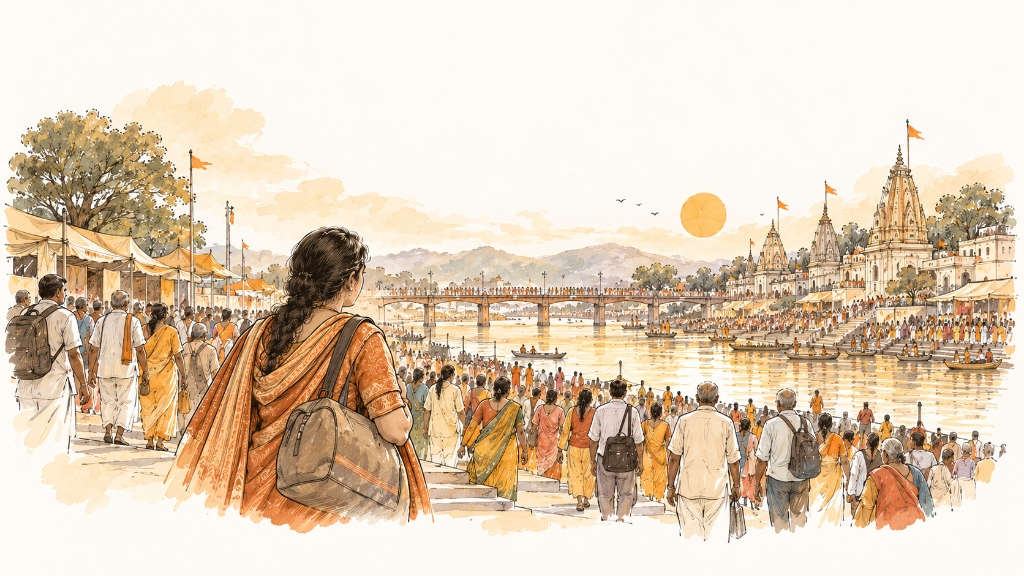
Picture a pilgrim arriving after a long journey.
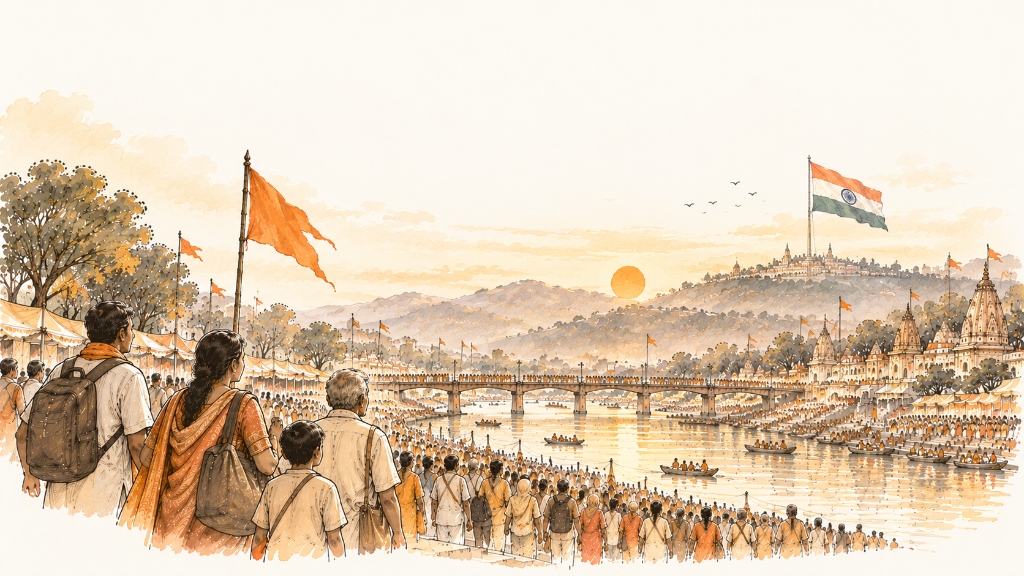
Picture a pilgrim arriving in Nashik after a long journey. She carries a small bag, her family’s prayers, and the hope of taking a holy dip. Around her, thousands of people move towards the ghats.
She needs a simple answer: Where can I find help?
Perhaps she speaks Marathi. Perhaps Hindi, Tamil, or another Indian language. She may not know the city. Her phone may have little or no network.
At that moment, technology should not ask her to learn a new system. It should help her take the next step.
This is the purpose behind KumbhDoot: a personal AI assistant, or Doot, designed to help each pilgrim find information, reach essential services, and experience the Kumbh in their own language. It is the vision guiding our work for Nashik Kumbh Mela 2027.
A journey that began before AI became an everyday word
Our story did not begin with a chatbot.
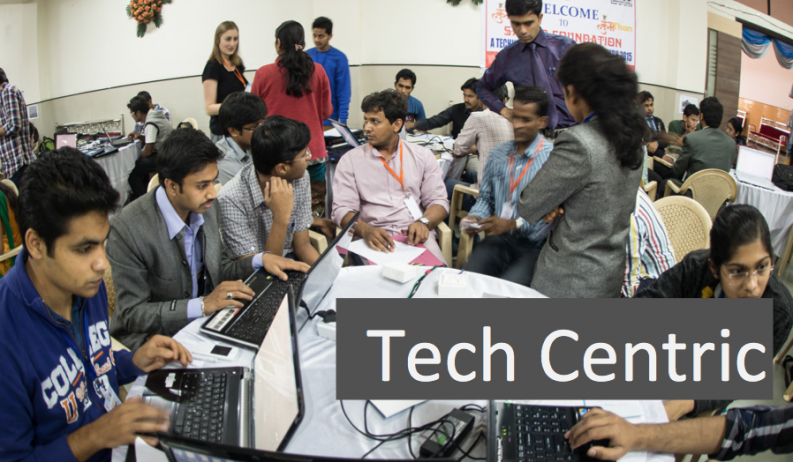
It reaches back to the Nashik Kumbh Mela of 2015, when the MIT Media Lab, the local administration, and other partners came together around a shared challenge: How could innovation help a city welcome millions of people? That collaboration helped shape a digital-first Kumbh Mela.
The work brought researchers, public officials, companies, and young innovators into the same space. They explored practical ways to understand crowd movement and improve services such as health, transport, food, and housing. The gathering became a place to build solutions around real human needs.
“The lesson we carry forward is simple. A city becomes smarter when its people are better informed and better supported.”
As we prepare for 2027, we are taking that idea closer to the individual. Alongside tools that help an administration understand a gathering, can we give every pilgrim a companion who helps them understand their own journey?
From a national stage to a pilgrim’s phone
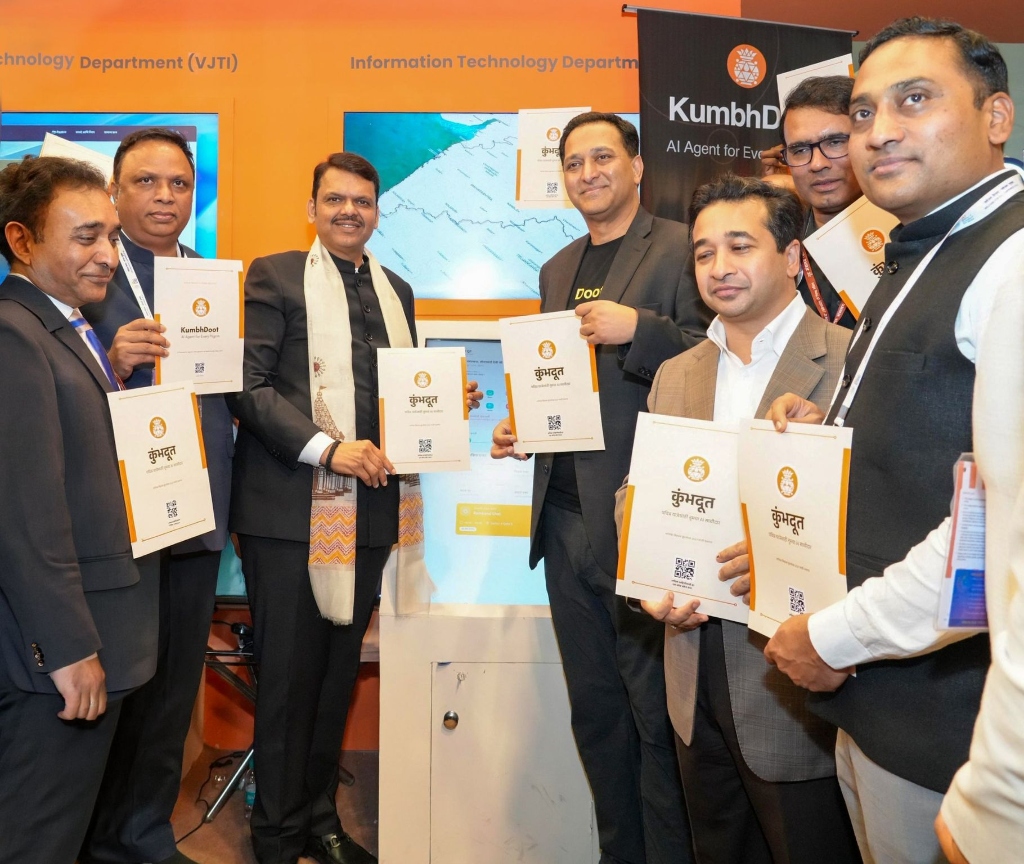
KumbhDoot took an important public step at the India AI Impact Summit 2026 in New Delhi.
Hon’ble Chief Minister of Maharashtra Shri Devendra Fadnavis launched the initiative in the presence of Minister Adv. Ashish Shelar, Minister Shri Nitesh Rane, and Chief Advisor to the Chief Minister Shri Kaustubh Dhavse. Senior ministry leadership and the Nashik administration were also present, including Divisional Commissioner Dr. Praveen Gedam and Kumbh Mela Commissioner Shri Shekhar Singh.
The occasion gave the vision a platform. Building it meant answering a much harder question: Would it remain useful where a pilgrim actually needed it?
After the launch, the Nashik-Trimbakeshwar Kumbh Mela Authority placed a demanding requirement for our team. The Doot should help even without a cellular network. As few questions as possible should need to travel to a distant AI system over the internet.
This was not only a question of network access. It was also a question of care. A pilgrim’s questions may reveal personal details about their location, health, or family. Sending every question away for processing creates avoidable exposure. The design therefore needed to reduce both network dependence and unnecessary data sharing.
A prepared sevak, not a distant help desk
We approached the problem through a familiar idea.
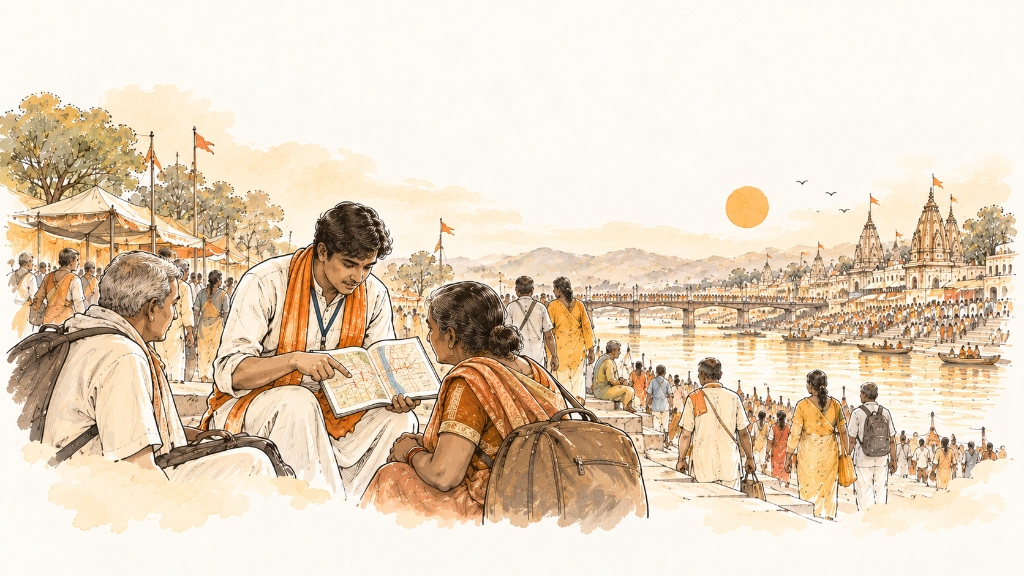
Think of a well-prepared sevak at the Kumbh. The sevak carries a small guide with official maps, important contacts, and answers to common questions. When someone asks for help, the sevak checks that guide first. There is no need to call a distant office for every answer.
KumbhDoot follows a similar approach.
A compact set of approved information is stored on the phone. The Doot first looks there for an answer. It can recognise that “Where can I get medical help?” and “Where is the medical camp?” may express the same need. For many common questions, it can provide stored guidance without asking a large AI model to write a new response. More complex requests can move to additional support when a connection is available.
“The principle is straightforward: use a trusted answer already available before asking a distant computer to create another one.”
This approach is designed to keep essential guidance within reach when the network fails. It also reduces the need to send routine questions outside the device.
The people turning the vision into service
Prof. Ramesh Raskar’s vision for an AI-first Kumbh places the citizen at the centre. The aim is to explore how people can use their own AI assistants to find help and connect with services.
Turning that vision into a useful pilgrim companion takes many hands.
Team members from Project NANDA and Kumbh Labs - including Saurabh Sakalkar, Ankur Shinde, Yash More, Mahesh Lambe, Gurusha Raskar, and Rekha Singhal - have helped turn a demanding requirement into a practical solution.
The Kumbhathon Innovation Foundation team provides vital ground support, helping connect the work to the realities of Nashik and the needs of the gathering.
“That connection matters. A design may look complete on a screen. Its real test is whether a tired traveller can use it, whether its words are clear, and whether its guidance helps someone reach the right place.”
Raising a dhwaja for AI for Bharat
In the spirit of the dhwaja raised to mark a sacred occasion, we see KumbhDoot as a flag for a new commitment: AI should come closer to the people it serves.
“Decentralised AI” can sound like a difficult phrase. For us, its meaning begins with a simple choice. Useful assistance should not depend entirely on one distant system. More of it should be available with the person, on their device, in a language they understand.
This ambition aligns with the IndiaAI Mission’s wider goal of making AI accessible and using it to address India’s needs.
For Bharat, inclusion must reach beyond those who have the newest phones, strong networks, or fluent English. It must guide how we build from the beginning.
The promise of KumbhDoot is therefore not that every pilgrim must understand AI.
“It is that AI must become useful to the pilgrim.”
As Nashik prepares to welcome the Kumbh, we are working towards that promise: a trusted companion for the journey, built through Indian knowledge, local participation, and public purpose.